
A business network should help identify problems and unexpected behavior without turning every communication into content to be read. When someone checks email, shares a document or uses an external service, the operational question is often: which device is communicating, with whom and in what pattern? It is not necessarily: what is that person writing?
Distinguishing observation of a connection from access to its content is a starting point for security that respects privacy. It also helps separate conclusions supported by the evidence from questions that need further investigation.
What TLS protects
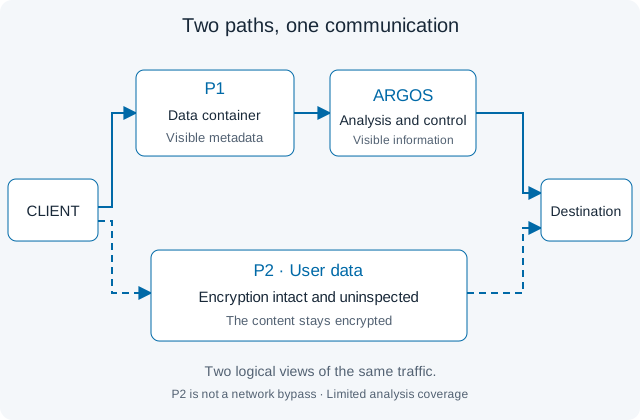
TLS protects communication between the two endpoints of a session. A network observer without the necessary secrets cannot read encrypted application content, such as a request body, message or document data carried inside the channel. This separation is fundamental to the protocol described in the TLS 1.3 specification.
Recognizing that a device is communicating with a service does not establish what it is doing there. An application label, when available, describes a traffic classification; it does not prove the content has been read or checked. Similarly, the absence of an alert does not certify that all transmitted data is harmless.
Which signals are useful
Depending on the observation point, addresses, ports, direction, data volumes and connection timing may be available. They help describe behavior: a device contacting many destinations, a transfer lasting much longer than usual or increased traffic at an unexpected time.
These signals need context. An address may be shared by many services, a connection may pass through a tunnel, and device identification depends on sensor placement and network structure. Some initial TLS information can also be protected: Encrypted Client Hello limits visibility into information such as the server name. It is therefore unreasonable to promise that every domain or application can always be identified.
An example: an after-hours transfer
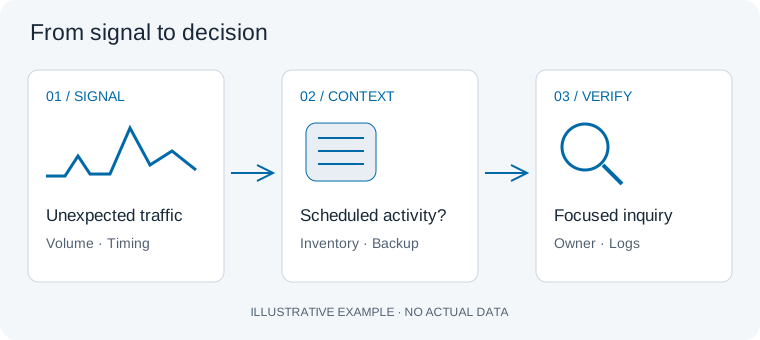
Imagine a computer sending more data than usual after the office closes. The volume and timing justify a check, but they could reflect a scheduled backup, an authorized synchronization or an activity requiring investigation. Encrypted traffic alone does not let you choose between those explanations with certainty.
A useful next step is to connect the signal to the inventory, identify the device owner and compare the timing with planned maintenance and procedures. If questions remain, an authorized person can check the relevant service or device logs. Blocking also needs an assessment of business impact: interrupting a legitimate backup can create a different problem from the one you intended to solve.
Content privacy and metadata care
Avoiding TLS interception keeps encrypted content outside network analysis. This offers a practical privacy benefit: monitoring does not need to open messages or documents to describe connection patterns. It does not make all collected information anonymous. Timing, addresses and associations between devices and people can still reveal working habits.
Define which information is needed for diagnosis and security, who may consult it and when it should be deleted. If an investigation needs additional data, set boundaries on the scope and duration of collection. Privacy also depends on these operational choices, not solely on encryption.
What to expect from Argos
Argos brings threat-detection events and traffic observations into the console. In selected zones, the prevention path follows marked flows beyond connection establishment, including replies. Excluded management traffic retains a separate path. If the engine is unavailable, that path is configured to allow traffic through. These boundaries matter when assessing failures or restarts.
This is not a promise of complete inspection of every flow or access to TLS content. The more extensive monitoring level adds passive observation, which does not itself mean blocking. Software activation requirements are not speed measurements or capacity guarantees: the configuration needs evaluation with the organization’s actual traffic and services.
Preparing an evaluation
Start with a small group of devices and known activities. Generate authorized communications, check which events arrive and document what remains invisible. Test maintenance and engine restarts in a test environment before introducing rules that affect people’s work.
The final question is whether the available information supports better decisions while keeping analytical limits and content privacy clear. For details of the revision, see DPI capabilities and limitations and the security documentation.