
Business infrastructure often grows through successive additions. One service handles email, another shares files, an appliance manages networking and a portal collects some events. Each choice may make sense at the time. Eventually, however, reconstructing the whole picture becomes difficult: who administers access, where does data travel, and which dependency is preventing people from working?
EDON starts with that question. The project separates governance of business services from governance of networking, making roles, integrations and the work needed to keep them operational more explicit.
Four letters and a starting point
EDON is an anagram of NODE. It refers to Node.js, the first runtime on which Atlas was built: the environment that executed its code. The name preserves a concrete connection to the project’s origins. Rearranging four letters takes us from the name of a technology to the name of an ecosystem.
That origin will feel familiar to anyone who builds software. Before catalogues, product pages and architecture diagrams come practical choices: where to run a program, how its components communicate, and how to turn an idea into something people can use. The name EDON retains a connection to that work, where a project takes shape through code.
The anagram carries this memory without requiring people using the products to know the technology behind its name. For a business, the value of Atlas lies in the activities it supports: accessing documents, managing identities, communicating and recovering a copy of its data. The name recalls the starting point; the services explain what the project does today.
From “node” to the idea of a node
There is also a way to read the name beyond its technical origin. We can use a node as an image of infrastructure: a point where people, information and services meet, connected to other points through a network.
Imagine an ordinary morning at work. Someone signs in with their business identity, opens a shared file, checks their email and calls a colleague. Behind these everyday actions are permissions, data and communications that need a place to operate. Atlas brings these services together in an environment the organization can administer. Seen this way, the node is where people’s work meets the systems supporting it.
The metaphor also offers a useful reminder: no node exists alone. Connections, dependencies and the responsibilities of its administrators matter. A well-organized service needs understandable access rules, recoverable copies and maintenance procedures. Control over infrastructure is built through those relationships too.
A name that accompanies the ecosystem
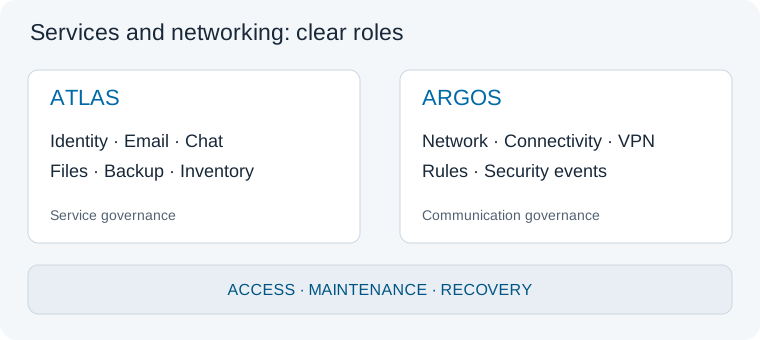
The name’s origin runs through Atlas; today EDON identifies an ecosystem with distinct responsibilities. Atlas handles business services and devices. Argos governs networking, connectivity and security. Citadel gives partners and customers a central management point for authorized instances. EDON Client brings access to services to users’ devices, including their phones when working away from the office.
To understand this distinction, imagine opening another business location. It needs identities and working tools, connections to other networks and people authorized to maintain the systems. These needs are related, but they call for different decisions. Seeing the whole as an ecosystem helps an organization choose which components to adopt and clarify each component’s role.
The four letters remain a small reminder of that story: a name originating in Node.js and Atlas that now accompanies a broader project. People discovering EDON can focus on the services they need or look more closely at the architecture. At every level, the aim is to make it possible to understand what they are using and retain control over their choices.
Fragmentation becomes visible during a problem
Imagine someone can no longer open a shared document. The cause could involve the device, credentials, permissions, file service or network path. When each element is managed separately, time is also spent finding who holds the information needed to diagnose it.
The same applies to planned changes. Altering a network or updating a service requires knowing who uses it, which connections it needs and how to verify that work can resume. Clear responsibilities reduce ambiguity in diagnosis and planning; they do not remove the need for skills and procedures.
Atlas: governing services and devices
Atlas is the business services node: identity, email, calendars, private chat, telephony, files and backup. Its purpose is to make these services part of a manageable environment, connecting everyday administration with organizational needs.
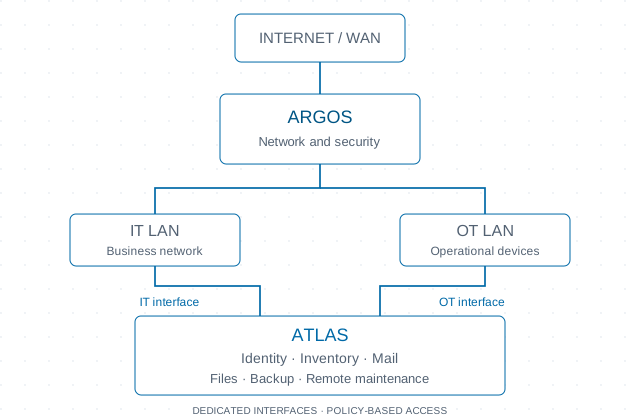
Through multiple interfaces, Atlas can also operate across IT and OT networks for tasks such as inventory and remote device maintenance. Those connections require defined access: reaching a device to administer it does not mean allowing unrestricted communication between every network connected to the node.
Argos: governing network communication
Argos handles connectivity, network rules, site links and traffic visibility. Here the questions concern which communications to authorize, which priorities to assign and which events need investigation. Separating this domain from services helps identify where to act when a policy or connection changes.
Evaluate Atlas and Argos together or integrate them into an existing environment. Separating roles is not itself a continuity guarantee: failures, maintenance and recovery need analysis for the actual configuration, including shared dependencies.
Control includes privacy
Managing email and files internally lets you choose where they reside, who can access them and which external integrations to enable. The business does not necessarily need to entrust content management to an external platform to obtain communication and collaboration services.
This choice carries practical responsibilities. Administrative access needs limits, systems need updates, backups need verification and retention needs rules. In networking, respecting encrypted content is a useful boundary; observed metadata also needs careful management.
Adoption starts with questions
Before choosing a configuration, identify essential services, user groups and devices. Establish who decides access, who performs maintenance and who can initiate recovery. Then select a bounded first evaluation with verifiable success criteria.
For example, a pilot might focus on file sharing for a small group: authentication, permissions, client access and recovery of a deleted document. A second step could check network behavior during planned maintenance. Results guide the next stage of adoption without relying on broad promises.
Evaluating the configuration
Compare the described capabilities with the revision and configuration you intend to use; software requirements do not replace sizing against real workloads. The project does not present unvalidated benchmarks or service levels.
The product datasheets, architecture and documentation provide a starting point for that assessment. Governing infrastructure also means being able to explain what you chose, why, and how you will respond when something changes.