
Choosing where a business service runs also means choosing what people’s work will depend on. Email, documents and access are more than catalog entries: they are everyday activities that need to remain understandable, manageable and recoverable. An external service can offer a clear benefit when its operating conditions are a deliberate choice.
“Cloud optional” expresses that design freedom. Keep some services in your infrastructure and integrate external ones that help your organization. Make the decision service by service, considering operations, privacy and your capacity to manage the result.
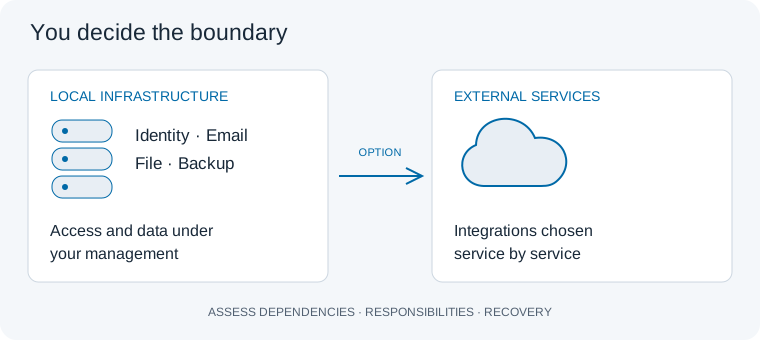
Start with the work that must continue
Before comparing platforms, list essential activities: accessing a document, signing in, consulting a calendar or communicating with a branch. For each activity, identify what happens when a dependency becomes unavailable. Without Internet access, opening a local file and exchanging email with an external recipient do not have the same requirements.
Server location alone does not describe continuity. Even a local application may depend on remote authentication, name resolution or a license check. Map the whole path from the user’s device to the service that delivers the result.
Make dependencies explicit
For each service, record who manages accounts, where data resides, which connections are required and who responds to a failure. Include the clients people use: a solution is useful when the full working process has been verified, not simply when the server starts.
Document sharing is one example. A file may reside locally, but access can require a directory, correct permissions, available storage and a recoverable backup. Writing down these relationships helps plan maintenance and determine which service to restore first.
Privacy: choosing where email and files reside
Managing email and files internally lets you govern storage, authorization and retention without necessarily entrusting content to an external platform. That can be an important criterion when documents contain designs, commercial relationships or confidential information.
Control also requires procedures: limited administrative accounts, updates, backups and access management. Integrations need attention too. A copy synchronized to an external service or a message sent outside the company follows a different path from data retained internally.
Assess cost alongside responsibility
A service costs more than its subscription or hardware. Administration time, training, support, recovery and eventual migration also count. A useful comparison includes the same activities for every option.
A local model assigns more tasks to the organization or its technical partner. An external provider may take on some activities, but users, permissions and integrations still need management. Setting those boundaries before adoption avoids leaving necessary work without an owner.
Test the exit before you need it
Ask how data and configuration can be exported, in which formats and with what dependencies. Then test a sample: recover documents, reconstruct permissions and verify that authorized users can work with them. An export button alone does not demonstrate that a service can be rebuilt.
Decide who keeps the instructions and how long the business can tolerate recovery taking. A small, repeatable test exposes problems that a commercial comparison may overlook.
Where Atlas and Argos fit
Atlas brings together business services such as identity, email, files and backup; Argos governs networking, connectivity and security. Evaluate them within your existing environment, choosing which services to keep local and which to integrate. Compatibility, sizing and procedures need verification in the proposed configuration.
Start with a non-critical service, a limited user group and a route back to the previous setup. Consult the architecture and datasheets to prepare an evaluation with clear objectives and responsibilities.